
Case 03 · Brand, product, automation
NATIX
Most studios hand you screens: no system behind them, no logic, and rarely tested. I came into NATIX to fix that.
TL;DR
- I came in on a brand-new product an outsourced agency left broken: design screens, no system.
- First, marketing. I rebuilt the brand, then systemized the assets with a mini design system, early Midjourney, and a ticketing workflow.
- That grew the community past 100k members and turned a new landing page into a big waitlist.
- Then the product. As the only designer, I turned one messy Figma file into a real component library, the last pass built with AI plus manual oversight.
- The system now lives in code, which gives AI clear context and bridges prototype to production.
- I helped the product reach 270k registered users, with two products shipped and more coming.
Design screens, no system
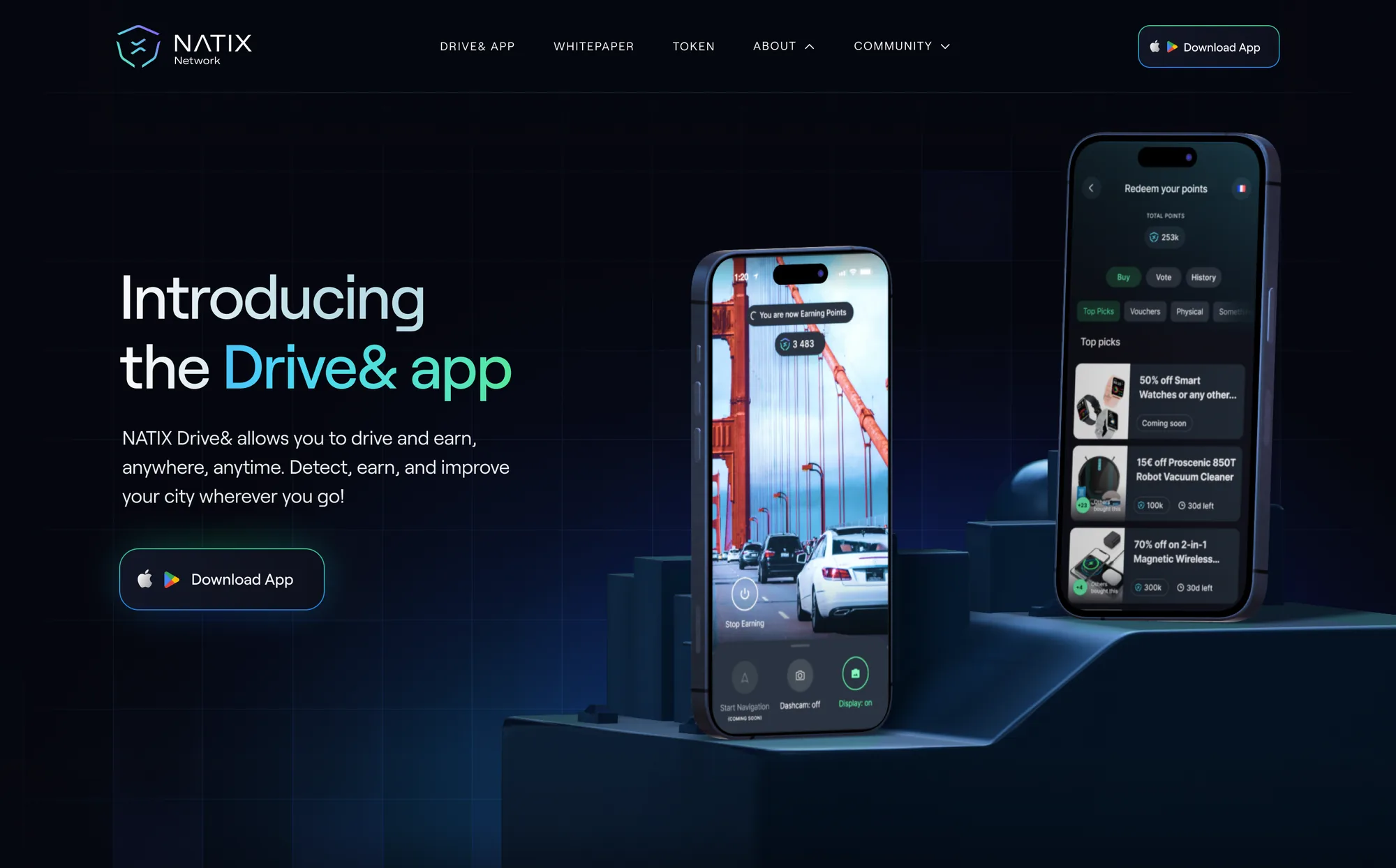
Most studios hand you design screens. No system behind them, no logic, and usually untested. That is what I walked into at NATIX, a web3 network that rewards drivers for sharing dashcam footage and turns it into AI training data for mapping and self-driving. I joined as the sole design consultant across both the marketing and product teams. The product was brand new and full of issues, because design had been outsourced to an agency that left screens with no components and no logic. Screens are the easy part. The system underneath is the hard part, and it is the part most studios skip. That is the part I build.
The brand
My first job was the brand. The old brandbook was thin: too few assets, too dark, and they did not fit the content or the content strategy. There was no room to adapt to different messaging. So I rebuilt it. I added visuals that actually fit the content, an icon pack to complement them, and a set of AI prompts so the team could generate more on-brand content on demand.

The marketing system
NATIX's social had to ship constantly and stay on-brand, so I built a small design system just for the assets. This was my first time using AI in the work, the earliest Midjourney back in 2023. The hard part was not generating images. It was fitting new assets into a system tight enough to stay consistent.
To run it, we built a ticketing system for marketing requests and visual creation. That turned a scramble into a real workflow the team could drive at volume, without waiting on me. The result: the community grew past 100k members, and a rebuilt landing page turned the demand into a massive waitlist.

The product system, the hard way
On the product side I was the only designer, and as it grew it needed structure. There was none. The agency had left a single Figma file with everything in it: ideas, drafts, and components, all mixed, before Figma even had sections or variables. The real problem was speed. It was almost impossible to track what was current design versus what was in production. That gap is what the design system had to solve.
I rebuilt it iteratively, one improvement at a time, so it could scale. There were so many versions of the recording screen it is wild to look back on. The last Figma iteration drew on a mix of proven design systems.

Why it lives in code
I have tested these tools as they appeared. It started in 2023 with Midjourney for visuals. Early 2026 brought Figma's Console MCP, from Southleft, which could create and manipulate even unstructured components, though JSON and the MCP protocol held it back. Figma's own AI copy-to-canvas was a step up, but the walls were real. You cannot upload all your assets, no videos and no heavy files, so you cannot truly prototype. The code it gives you is React and Tailwind, so a custom stack is off the table. And the billing climbs fast.
So I moved the whole process to a local, coded prototype. No stack lock-in, no single model, no Claude Design, and no runaway billing. If one model doubled its price tomorrow, I would swap the model and the harness and keep moving.
A self-improving workflow
The design system in code is what makes this work. Each component carries its own context, its references and the reasoning behind it, so any AI agent is instantly on track. The UI it generates is staggering, consistent and close to polished, and rules like optical alignment sharpen it further. Every change gets written into a memory file, so the system improves itself. Add real user feedback, and prototyping only gets faster.
The setup is simple. I build the prototype locally in React, Ant Design, and Tailwind, all heavily customized. It goes to GitHub to share code with stakeholders, and to a Vercel link for testing with users and other teams. The final polish happens back in Figma, where copy-to-canvas cleans up the prototypes, edge cases and empty states included.

Still building
None of this was a hand-off. I am still embedded with NATIX. As the team grew, another agency came in to assist, and my role expanded to product design and mentoring their designer and product assistant. The proof is in the numbers. On marketing: over 100k community members and a big waitlist. On product: 270k registered users and two products shipped, with more coming. Not a pile of screens. A product that keeps growing on a system built to carry it.
When anything can be built, systems hold it together
With AI, the old limits on building product are gone. You can ship fast, and you can ship almost anything. That is exactly why systems matter more than ever. When anything is possible, a design system and a well-defined spec are what hold a product together, because they set the constraints on purpose. Without them, speed just makes a bigger mess, faster.
That is what I build. I embed and set up the systems most studios skip: the brand, the marketing assets, and the product design system, with AI and automation throughout, so your team moves fast without losing the thread. It fits whether you are funded and scaling, pre-seed and watching every dollar, or building your first thing. The call below is the fastest way to see what your system would look like.
Next case study · Case 01
 Kurohudas
Hi, I'm Lukas, founder of Ramojus.
I design and build products end to end.

 Book a call
Cal.com, 30-min call